Tools I’ve loved making.
NPBloom
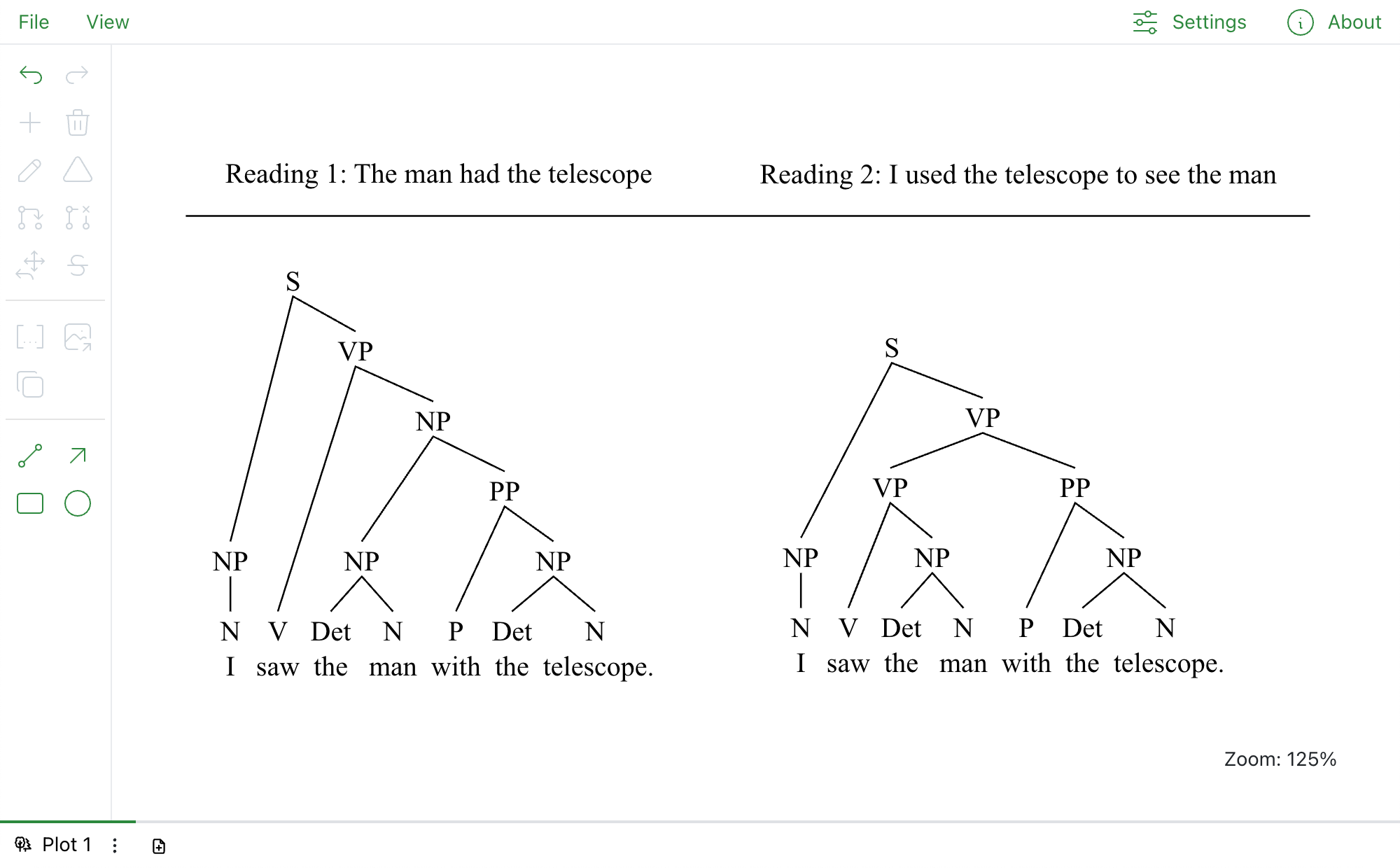
A tool for drawing linguistic syntax trees the way you’d draw them on paper.
It spread almost entirely by word of mouth among professors, TAs, and students, and is now their go-to tool for this purpose.
Usability in tools for linguists often leaves a lot to be desired, and I wanted to raise the bar by building a tool that was a pleasure to use.
The highlight of my academic career was when a question on a final exam asked students to examine a tree drawn with NPBloom. I was one of the students taking that exam.
Mill Market
An online marketplace letting tree services sell their waste logs as material for wood products. I owned the UI and an SMS-based system for coordinating pickups: scheduling, rescheduling, delivery estimates, and more. SMS was where our non-technical users already lived, and getting them to download an app would have been a non-starter.
Forward Forestry was acquired by Cambium in 2024 and the whole team came along. I continued to work on the product and its integration into the Cambium ecosystem, this time implementing a design team’s vision instead of my own, down to the small details the lead designer was glad someone noticed.
The notification system had an especially interesting design and testing process. See more...
A notification system is a high-stakes component of any product, and it’s critical to get it right. Accordingly, it was the most heavily tested part of the codebase.
I wrote a little language where each case reads like a screenplay: a timed exchange of messages a non-coder can follow like a script for a movie scene,
to pass to a product manager or designer and ask, “Does this look right?”
The very same screenplay would then compile down as valid test cases, since it was all valid code in the first place.
This made it easy to get feedback from non-technical stakeholders and iterate quickly, without needing to translate back and forth between English and code.
The content of each test case looked like this (this is heavily extended Kotlin code which compiles as-is):
At time "2023-05-29T14:00:00"
Send dispatcher "What is your ETA for tomorrow at 123 Main St, Anytown, US?"

2 minutes later
Dispatcher replies "10 am"
Send dispatcher "You have set a time of 10:00 for tomorrow. We're confirming this with the supplier..."
Send supplier "Can you load tomorrow at 10:00 at 123 Main St, Anytown, US?"

5 minutes later
Supplier replies "Yes"
Send supplier "Thank you for confirming!"
Send dispatcher "The supplier has confirmed a pickup time of 10:00 tomorrow. We'll text you tomorrow before the pickup in case there are any changes."
The tests would run against a simulated notification system with a fake clock. Each replies line would trigger a response from one of the fake users, the Send lines would check that the system reacted correctly at the right time, and the later and At time lines would advance the clock and trigger any time-based events that were supposed to happen in the meantime.
We had about 150 such test cases covering a wide variety of corner cases. We would run them before each deployment, and any deviation from the script would cause the test to immediately fail and abort the deployment.
Many bugs did not make it to production thanks to this system, including ones that would have been tricky to catch, annoying for the users, and highly impractical to reproduce manually.
Smaller one-offs
-
theirnameis (2025). Christmas time with my family in Iceland is a linguistic obstacle course, where all the names on the gifts need to be inflected correctly.
To “Jón”? “Jóni”? “Jóns”?
Worry no more: input a name and get all of its inflected forms. Try it ↗
Built with VanJS ↗. Sources information from Wiktionary where needed. - Early projects throughout high school (2012–2015). These included the aforementioned spatial geometry visualizer, a quote database for my classmates, and a four-dimensional Snake game (still available here ↗).